Showing posts with label Craveri's murrelet. Show all posts

Tuesday, August 16, 2016

THE MIXING ZONE: HALF MOON BAY PELAGIC TRIP REPORT


AUGUST 13, 2016
Shearwater Journeys' August 13, 2016 pelagic trip departing from Pillar Point, Half Moon Bay was simply put— over the top — with very exciting seabirds, whales and dolphins. Highlights included: the NORTHERN GANNET at Pillar Point; a BROWN BOOBY on a rusting barrel offshore; a GRAND SLAM: POMARINE, PARASITIC, LONG-TAILED JAEGERS & SOUTH POLAR SKUA; SABINE'S GULLS; ARCTIC TERNS; and SCRIPPS'S & CRAVERI'S MURRELETS; ASHY, WILSON'S and FORK-TAILED STORM-PETRELS. Cetacean highlights included: 11 BLUE WHALES, 4 FIN WHALES, 120 HUMPBACK WHALES; 350 PACIFIC WHITE-SIDED DOLPHINS and 4 NORTHERN RIGHT WHALE DOLPHINS.

The sea surface temperature chart showed a messy area of mixing temperatures near the weather buoy. Indeed, we tracked temperatures throughout the day as they rose from 54 F to 59.45 F. The "mixing zone" turned out to be loaded with feeding seabirds and marine mammals. 
Chart used by permission of Terrafin, a service that I subscribe to.
SCRIPPS'S MURRELET, above, was one of two that we observed. 
Two CRAVERI'S MURRELETS popped off the water almost immediately as they were called out. They did what so many murrelets do: fly over the edge of the Earth! 
At least a few lucky and fast birders saw and photographed them. 
The dusky wing-linings are a definitive ID characteristic.
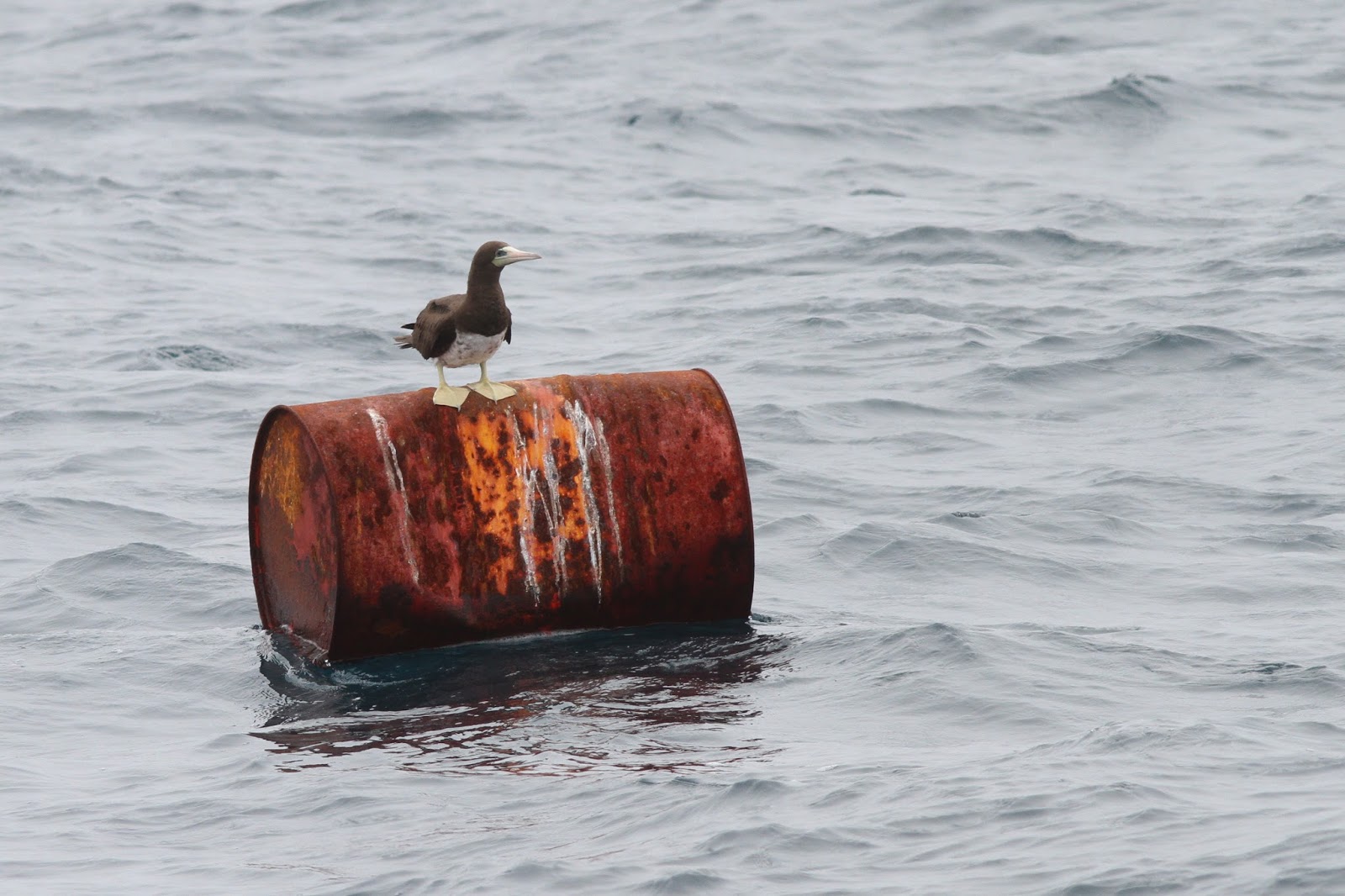
An adult BROWN BOOBY was sitting on a rusty barrel well offshore.
Brown Boobies have not been as common this season as last year.


Some high flying folks were on board. 
OLAF DANIELSON who is doing a BIG YEAR, above with L.

CHRISTIAN HAGENLOCHER, who is also doing a BIG YEAR, above with good friend, Casey.
This was the first trip of the season to hit a GRAND SLAM:
POMARINE, PARASITIC (above), & LONG-TAILED JAEGERS
SOUTH POLAR SKUA
A POMARINE (right) and PARASITIC JAEGER (left).
A great group of fun, young birders on board!
Many thanks to all of the fun participants who joined us from near and far for this almost 12 hour pelagic trip. This was an excellent day at sea for both seabirds and marine mammals. 

It takes a team to make such a day. Leaders on this trip included: PETER PYLE, STEVE TUCKER, JIM HOLMES, WILL BROOKS, and DEBI SHEARWATER. This trip was submitted to eBird following pelagic eBird protocol. 

THE COMPLETE SPECIES LIST FOR SHEARWATER JOURNEYS'
AUGUST 13, 2016 HALF MOON BAY PELAGIC TRIP FOLLOWS:
SAN MATEO/SAN FRANCISCO COUNTIES:

COMMON LOON- 4/0
WESTERN GREBE- 2/0
BLACK-FOOTED ALBATROSS- 20/40
NORTHERN/PACIFIC FULMAR- 0/5
PINK-FOOTED SHEARWATER- 75/150
SOOTY SHEARWATER- 2,000/250
WILSON'S STORM-PETREL- 1/0
ASHY STORM-PETREL- 10/20
FORK-TAILED STORM-PETREL- 1/1
BROWN BOOBY- 0/1
NORTHERN GANNET- 1/0
BROWN PELICAN- 30/0
BRANDT'S CORMORANT- 15/0
DOUBLE-CRESTED CORMORANT- 2/0
PELAGIC CORMORANT- 2/0
RED-NECKED PHALAROPE- 80/30
RED PHALAROPE- 10/2
SOUTH POLAR SKUA- 0/1
POLMARINE JAEGER- 0/1
PARASITIC JAEGER- 1/1
LONG-TAILED JAEGER- 0/3
HERRMANN'S GULL- 10/0
CALIFORNIA GULL- 10/8
WESTERN GULL- 200/25
SABINE'S GULL- 0/12
COMMON TERN- 0/1
ARCTIC TERN- 0/3
COMMON MURRE- 400/40
PIGEON GUILLEMOT- 7/0
SCRIPPS'S MURRELET- 2/0
CRAVERI'S MURRELET- 1/2
CASSIN'S AUKLET- 450/450
RHINOCEROS AUKLET- 7/2
BROWN-HEADED COWBIRD- 0/1, offshore
CALIFORNIA SEA LION- 35
STELLER'S SEA LION- 2
NORTHERN ELEPHANT SEAL- 3
MINKE WHALE- 1
BLUE WHALE- 11
FIN WHALE- 4
HUMPBACK WHALE- 120
NORTHERN RIGHT WHALE DOLPHIN- 4
PACIFIC WHITE-SIDED DOLPHIN- 350
HARBOR PORPOISE- 20
UNIDENTIFIED CETACEAN-1 (thought to be a large dolphin, best left unidentified)
OCEAN SUNFISH- 4

UPCOMING TRIPS DEPARTING FROM HALF MOON BAY
AUGUST 19
SEPTEMBER 4, 16, 18
OCTOBER 2, 9
UPCOMING TRIPS DEPARTING FROM MONTEREY BAY
AUGUST 26
SEPTEMBER 3, 7, 8, 9, 11, 14, 15, 23, 24, 25
OCTOBER 1, 8, 16
GREAT TIME TO HEAD OFFSHORE!
LIVING THE SALT LIFE,
Debi Shearwater
debi@shearwaterjourneys.com
Seabird images by Nathan Goldberg


Thursday, August 14, 2014

LOVING SEABIRDS: Half Moon Bay, Monterey Bay & Farallon Islands Seabirding Pelagic Trips

Late Summer & Early Seabirding Pelagic Trips:

A SNAPSHOT IN TIME
Shearwater Journeys operated six pelagic trips during late summer (July 20 & 26 from Half Moon Bay) and early fall (August 1 & 8 Monterey Bay and August 2 Half Moon Bay) and a trip to the Farallon Islands on August 3. This is a recap of those trips, including trends that we noticed regarding warm water, food, locally breeding birds and meg-rare seabirds.
TERRAFIN CHART used by express permission. 
Most years, I have noticed a surge of warm water from the south during July or mid-August. I've called it, The Great Southerly Push. Some years, it doesn't happen. This year, however, it happened in early July and was very strong. This lead many people to speculate about El Nino and its' arrival in our area and it bringing many incredible seabirds, but I was not one of them. 

A larger ocean system, The Pacific Decadal Oscillation (PDO), the long term ocean fluctuation of the Pacific Ocean sort of overlays El Nino systems. PDO's run about 20 to 30 years long and we are in the midst of one, right now. The present PDO might last until about 2023. It seems that the PDO has muted most of any effects that might have happened had an full blown El Nino reached our area. The August 7 Alert by NOAA has reduced the likelihood of an event reaching California to 65% and predicted arrival time moved to August - October. Strength is predicted to be weak or moderate rather than strong. As Peter Pyle states, "In my long history looking at weather (my dad was a meteorologist), once conditions and forecasts begin to back off, they usually continue to do so. Hopefully we will at least get enough El Nino to bring us some rain this winter!"

Shearwater Journeys has nearly four decades of offering offshore pelagic birding trips. We've seen what small El Nino's look like, as well as what really big El Nino's look like, such as the 1982-83, or 1998 events. It is a big deal. We were not in a so-called "cold water regime" during those years. So, if Pleuroncodes planipes, Red Crabs, begin to show up on the shores as they did in 1982, you'll know we're in for a big one! For now, however, it appears that the dire El Nino forecasts that were put out earlier this year are not likely to materialize. This doesn't mean that we don't have some warm water offshore! We do, indeed. But not every seabird we see is related to warm water conditions. 

If you've been on a pelagic trip with me, you've probably heard me say: "Food is not evenly distributed at sea. It is found in patches." This is why there are sometimes "dry spells" during a pelagic trip. Note: Dry spells are usually very, very short, if at all on central California trips, because these waters are some of the most productive on Earth! Food and the search for prey is what being a seabird is all about! 
It comes as no surprise then, that thousands of SOOTY SHEARWATERS and 20-30 Humpback Whales have been  gorging on a mass of anchovies near Moss Landing! Above, is the view on the fish finder of a school of anchovies off Point Pinos, Monterey on our August 8th pelagic trip. Thousands of Sooty Shearwaters were feeding over this school of anchovies. At this time of year such feeding flocks of shearwaters are almost 100% homogeneous— Sooty Shearwaters. This will change over the coming weeks as mixing of the seas brings in other species of shearwaters such as Buller's Shearwater. But, early in the season, these nearshore feeding flocks are comprised mostly of Sooty Shearwaters. Black-vented Shearwaters arrived earlier than usual (if they even come), from southern California. Since they are dwellers of the Continental Shelf, some have been seen in the feeding flocks, or from sea watches along the coastal points. Anchovies are the "stuff of life" for shearwaters! This is a reminder that farmed salmon are feed pellets made from harvested anchovies — yet one more reason why you should avoid farmed salmon! 
If anchovies are the "stuff of life of shearwaters," squid is the "stuff of life" for albatrosses. Last fall and this fall, we are seeing good amounts of squid in both Monterey Bay and Half Moon Bay. This has a double-edged effect. Peter Pyle noted on our July 20th Half Moon Bay trip that he has rarely seen BLACK-FOOTED ALBATROSSES so close to shore. Indeed, albatrosses were in to the 30 fathom line, as well as being seen off Point Pinos, Monterey Peninsula. I suspect that it was the prospect of feeding on squid that brought them so close to shore. That, and the possibility that they were not finding enough food further offshore. This makes viewing albatrosses very nice for the seabirder. The down side is the squid fishing industry which almost certainly impacts the endangered MARBLED MURRELETS. Squid fishermen work at night, using lights to attract the squid to the surface, and nets to make the haul. It is well known that seabirds are attracted to lights at night. So, it is likely that these murrelets are being impacted by this fishery. Certainly, it makes them much more difficult to find on Half Moon Bay trips, the only place where we routinely see Marbled Murrelets. Once the fishing stopped last fall, the murrelets were easily found. 
Tuna fishermen look for certain seabirds that indicate to them that ALBACORE might be around. These birds include BULLER'S SHEARWATERS and ARCTIC TERNS. Fishermen call them, "tuna birds." It was not terribly surprising to find a Buller's Shearwaters with these conditions. I always associate FLESH-FOOTED SHEARWATERS with the Buller's Shearwaters. (They breed on the same island). So, FLESH-FOOTED SHEARWATER didn't surprise me, either. (There are records for every month of the year, although mid-September through November is the peak). Indeed, on our July 20th Half Moon Bay trip, we saw an albacore jump out of the water. That's called a "jumper." But, the albacore were not biting. And, we saw seabirds that I associate with albacore as well, especially the CRAVERI'S and SCRIPP'S MURRELETS. These birds prefer crystal, clear, deep dark aqua, or even, black seas. Since the July 20 and 26th Half Moon Bay trips, the seas have calmed and there are no "edges" where warmer water meets the colder water. However, just wait, this too will change. We might yet see biting albacore on the September 13th ALBACORE TRIP departing from Monterey. (We have found RED-TAILED TROPICBIRD on past albacore trips! We will be actively searching for warm water!)
 CRAVERI'S MURRELET, above, appeared in central California for the first time in nearly a decade. The appearance of this species is definitely linked to the super warm water surge that began in July. 
HAWAIIAN PETRELS are now known, from radio tagging,  to be a part of our "regularly" occurring offshore species. However, intersecting with one is really a matter of luck and timing. July through September is about the best time to hope to see this rarity. We have found them on trips departing from Monterey, Half Moon Bay, Bodega Bay, and Fort Bragg. On one Fort Bragg trip, we found three in one day and on another trip, we followed one for 17 minutes! These petrels are thought to use high pressure systems. And, we had one in place, offshore for a week prior to this sighting. 
SALVIN'S ALBATROSS above and below, was a big surprise. There is only one other record for this species, Alaska. So, it is a first for the lower 48 and a state bird for California. The appearance of this southern albatross may or may not be related to warm water. July/August is the time of year when  a number of southern seabirds have occurred. Most notable have been: GRAY-FACED/GREAT-WINGED PETREL, TASMANIAN SHY ALBATROSS, CHATHAM ALBATROSS, LIGHT-MANTLED SOOTY ALBATROSS and there are two summer/fall records of WANDERING ALBATROSS. 
Rare and mega-rare seabirds are not to be expected, of course. But, the list of rarities is quite long! It will be interesting to see how the mixing of the warm and cold water progresses. Today, I noticed a "bubble" of cold water on the SST chart for Monterey. Yes, temperature "fronts" do not necessarily run in straight or even crocked lines. I once followed a warm/cold water temperature break, and it took me around in a circle! That's a bubble! It all looks like water out there — there's a lot more to it! 
BY-THE-WIND-SAILORS were quite prevalent in mid-July, but their numbers have been declining since then. Could be that they got blown around. This is the first time I've seen these darlings of the sea since 2005! I don't know if their appearance is related to warm water. I doubt it, though. In year's past, we typically saw rafts of them during spring. 
A LEACH'S STORM-PETREL, above, was a surprise on our July 20th Half Moon Bay trip because they are usually found very far offshore, 50+ miles. There's no rhyme or reason for this, IMHO.  
LAYSAN ALBATROSS showed up on our July 26 Half Moon Bay trip and our August 3 Farallon Island trip. I speculate that most of the Laysan albatrosses that we see during July and August are from the breeding colony in Mexico where some 400 pairs now breed. All of the leg bands that we have been able to read by digital images, have been of albatrosses from Mexico. They seem to be establishing a "regular" occurrence along the central California coast during July and August. Prior to the establishment of the Mexican colony in the mid-1980's, this species was very, very difficult to see in California. 
The Farallon Islands National Wildlife Refuge are home to the largest breeding seabird colony south of Alaska on the West Coast. All of the breeding seabirds at the Farallon Islands seem to be having a good season. Earlier in the summer, quite a lot of krill was around which is a great food source, especially for CASSIN'S AUKLETS. Our main target bird of the August 3 trip was the TUFTED PUFFIN, pictured above, which are having a good season with 75 active sites!

It has been a terrific and inspiring beginning to our 39th year of pelagic seabirding trips! There's still a lot ahead — 27 more trips, in fact! Bring on the jaegers, storm-petrels and Arctic terns! Things are looking good. 

Shearwater Journeys thanks all of the folks, from near and far, who joined us on these first six trips of the season. Folks hailed from Finland, England, New Zealand, United Arab Emirates, Canada, Sweden as well as many states in the USA. One look at the faces of the "Dads and Chicks" on our July 20th trip  shows just how much FUN they had!

Leaders who were on board for these trips included: Peter Pyle, Todd McGrath, Scott Terrill, Linda Terrill, Steve Tucker, Abe Borker, Jim Holmes, Al De Martini, Nick Levendosky, Rick Fournier, Jennifer Green, and Debi Shearwater.

Remember this is just a "snapshot in time" and things change constantly!
The ocean is a dynamic and complex world. We hope you will join us!

SHEARWATERS FOREVER,
DEBI SHEARWATER
debi@shearwaterjourneys.com 


Wednesday, August 13, 2014

IMAGES OF THE DAY BY ABE BORKER: JULY 26, 2014 HALF MOON BAY

Shearwater Journeys's leader, Abe Borker captured these images on our July 26, Half Moon Bay pelagic birding trip. From largest to smallest — 
SALVIN'S ALBATROSS
SALVIN'S ALBATROSS
SALVIN'S ALBATROSS
SALVIN'S ALBATROSS
BLACK-FOOTED & SALVIN'S ALBATROSSES
BLACK-FOOTED ALBATROSS
 NORTHERN (PACIFIC) FULMAR
CRAVERI'S MURRELETS 
 CRAVERI'S MURRELET
CASSIN'S AUKLET
 BY-THE-WIND-SAILORS
 Abe is currently en route to Antarctica where he studies seabirds. 
All images, copyright, Abe Borker.
Please do not use without permission. 
LIFE IS GREAT — AT SEA ON A SUCH A DAY AS THIS! 
ALBATROSSES FOREVER,
DEBI SHEARWATER
debi@shearwaterjourneys.com

Tuesday, August 12, 2014

THREE PELAGIC BIRDING TRIPS: 33 SPECIES OF OCEAN BIRDS

FINDING SEABIRDS with SHEARWATER JOURNEYS

Pelagic birding is often described as "the last frontier" of birding. I can clearly remember looking at the plates of jaegers, shearwaters, storm-petrels, and alcids in my Petersen Texas Field Guide in 1971! Well, we've come a long way since that time. Nearly four decades of seabirding trips with thousands of birders on board, we have perfected pelagic birding as best as anyone in the world. 
In fact, many other operations have taken inspiration from us!
I always advise birders who are traveling a long distance to reach our seabird-rich area to try to do more than one trip, and from more than one port. So, let's take a look at how that would have played out, had you booked the Shearwater Journeys's August 1 Monterey Bay trip, August 2 Half Moon Bay trip and August 3 Farallon Islands trip departing from Sausalito. 
Below the images, you will find the complete species list for each day. I did not include the rocky shorebirds. 
 As can be seen from the lists, the MONTEREY BAY trip on AUGUST 1 was the best trip for seeing BLACK-VENTED SHEARWATERS, above! Monterey is always a good place for getting one's feet wet with pelagic birds. It is a good option for the beginning sea birder who wants to learn the differences in flight patterns which are often the first critical clue about a bird. For instance, the Black-vented Shearwater has a faster wingbeat than the Sooty Shearwater. This is hard to "learn" when one sees only one or two Black-vents. But, the Monterey trip had over 100 Black-vents, giving the observer more opportunity to study the flight differences. 
Of the three trips, only the Monterey trip found SABINE'S GULLS
Every sea birder dreams of the mega-rare seabirds. Well, they are rare because we rarely see them! 
Hands down, the star seabird of our AUGUST 2 HALF MOON BAY trip was the HAWAIIAN PETREL, above. 
 While Monterey is a great starting point for beginning sea birders, it also remains an excellent place for intermediate and advanced sea birders, as well. Witness the fact that I spotted a HAWAIIAN PETREL on the AUGUST 2, 2013 MONTEREY BAY trip! 
Even before the petrel showed up, we had tallied some "good species."
CRAVERI'S MURRELETS, above, showing dark wing linings and SCRIPPS'S MURRELETS, below, showing white wing linings, are highly sought after small alcids in our area. 
These little treasures were ONLY found on the AUGUST 2 HALF MOON BAY trip. 
Note that Craveri's Murrelets have not shown up in central California for nearly a decade, and may not do so, again. So, if you are looking for this species, in particular, be advised: Get on a Half Moon Bay trip as soon as possible, or one of the Bodega Bay trips: September 1 & 19, this year! Don't wait until next year, as Craveri's Murrelet may not show up!
The Half Moon Bay trips are the ONLY trips were the endangered MARBLED MURRELET, below, is regularly encountered. 
So, by adding the Half Moon Bay departure to the Monterey Bay departure, one can increase the total species list dramatically. 
For our last trip in this sequence, we head to the Farallon Islands, departing from Sausalito. 
Note that we started on the southern central coast in Monterey and are now working our way north.
In addition to the iconic Golden Gate Bridge, we seek the cheeky TUFTED PUFFIN, in particular on our AUGUST 3 FARALLON ISLAND trip. We have a 100% success rate for Tufted Puffin on our August Farallon trip, and this one was no different. 
However, we add a bonus bird: the NORTHERN GANNET (the white speck in the image below), which has been at the islands, off and on, for three years! 
 
Not too far from the gannet, a BROWN BOOBY is perched on Sugerloaf, too!
This is another "bonus seabird."
 Most of the trip to the Farallon Islands takes place on the Continental Shelf. After touring the islands, we head to the edge of the shelf, hoping to see shearwaters and Black-footed Albatross, which we do. 
Suddenly, in flies a LAYSAN ALBATROSS, yet another "bonus seabird"!
No one trip tallies as many species of seabirds. 
By doing all three trips, you would have tallied a MEGA-RARE SEABIRD, HAWAIIAN PETREL; other rarities: NORTHERN GANNET & BROWN BOOBY; harder-to-find-seabirds such as SCRIPPS'S, CRAVERI'S & MARBLED MURRELETS; and EIGHT SPECIES OF ALCIDS!
Think about it this way:
When you visit one of your favorite land birding migration spots, be it Cape May, NJ or High Island, TX, you plan to spend more than one day birding there. 
It is, after all, migration — even though you walk the same trails, and look in the same tress, each day is different. 
Well, finding ocean birds works the same way. Plan for more than one day and you will almost certainly add more species! 
Smart Birding!
SEABIRDS SIGHTED ON SHEARWATER JOURNEYS'S
AUGUST 1, 2, 3, 2014 TRIPS
MONTEREY/HALF MOON BAY/FARALLON ISLANDS
1. RED-THROATED LOON- 0/2/0
2. PACIFIC LOON- 0/1/0
3. WESTERN GREBE- 0/0/100
4. LAYSAN ALBATROSS- 0/0/1
5. BLACK-FOOTED ALBATROSS- 27/53/12
6. NORTHERN (PACIFIC) FULMAR- 9/9/6
7. **HAWAIIAN PETREL- 0/1/0
8. PINK-FOOTED SHEARWATER- 84/310/30
9. SOOTY SHEARWATER- 21783/1935/400
10. BLACK-VENTED SHEARWATER- 161/3/0
11. BROWN PELICAN- 71/335/10
12. ** NORTHERN GANNET- 0/0/1
13. **BROWN BOOBY- 0/0/1
14. BRANDT'S CORMORANT- 1321/50/2020
15. DOUBLE-CRESTED CORMORANT- 2/60/9
16. PELAGIC CORMORANT- 5/2/10
17. RED-NECKED PHALAROPE- 158/17/15
18. RED PHALAROPE- 3/0/0
19. PARASITIC JAEGER- 1/2/5
20. HEERMANN'S GULL- 29/2/32
21. CALIFORNIA GULL- 30/2/32
22. WESTERN GULL- 273/100/550
23. SABINE'S GULL- 2/0/0
24. ELEGANT TERN- 114/290/75
25. CASPIAN TERN- 3/0/0
26. COMMON MURRE- 461/280/1520
27. PIGEON GUILLEMOT- 12/12/325
28. MARBLED MURRELET- 0/2/0
29. SCRIPPS'S MURRELET- 0/2/0
30. CRAVERI'S MURRELET- 0/6/0
31. CASSIN'S AUKLET- 3/5/20
32. RHINOCEROS AUKLET- 6/4/12
33. TUFTED PUFFIN- 0/0/23
MARINE MAMMALS:
1. SEA OTTER- 15/0/0
2. CALIFORNIA SEA LION- 250/30/ 400
3. STELLER'S SEA LION- 0/0/30
4. NORTHERN FUR SEAL- 0/0/400
5. HARBOR SEAL- 5/0/85
6. HUMPBACK WHALE- 1/6/2
7. RISSO'S DOLPHINS- 21/0/2
8. HARBOR PORPOISE- 0/12/8
9. DALL'S PORPOISE- 21/0/0
OTHER:
1. OCEAN SUNFISH- 12/10/18
2. BY-THE-WIND-SAILORS- +
Our trips are set up so that they can be combined, doing trips from different ports and working in the same direction from north to south (not back tracking). If you travel any distance to do find seabirds on the West Coast, your biggest expenses are getting here and staying here. Take in as many trips as you can while you are here.
Once, two Cornell Lab of Ornithology staff signed up for every single trip on Shearwater Journeys's schedule for the month of September. They LOVED seabirds and were rewarded with a STREAKED SHEARWATER on the last trip!
You might wonder if I take my own advise. YES, of course I do. 
When I last visited Kaikoura, New Zealand, another seabird mecca, I signed up for SIX trips! 
GET OUT THERE! 
SEPTEMBER IS USUALLY THE VERY BEST MONTH FOR SEABIRDS!
SHEARWATERS FOREVER, 
DEBI SHEARWATER
debi@shearwaterjourneys.com

All images, copyright, various.
Please do not use without permission.


Monday, August 11, 2014

IMAGES OF THE DAY BY DAVID PAVLIK: AUGUST 2, 2014 HALF MOON BAY

Birders on Shearwater Journeys's August 2, 2014 trip from Half Moon Bay were thrilled by the appearance of a HAWAIIAN PETREL! It was quite a day at sea! I hope you will enjoy these images by David Pavlik who also was with me on the August 2, 2013 Monterey Bay trip when I spotted a HAWAIIAN PETREL! What are you doing August 2, 2015?
HAWAIIAN PETREL!
BLACK-FOOTED ALBATROSS
SCRIPPS'S MURRELET, above and below!

 CRAVERI'S MURRELETS, above and below!
 PARASITIC JAEGER
 HAWAIIAN PETREL!
All images by David Pavlik.
Please do not use without permission.
SEE YOU OUT THERE!
PETRELS FOREVER,
DEBI SHEARWATER
debi@shearwaterjourneys.com