Showing posts with label Expeditions. Show all posts

Sunday, April 12, 2009

STAFF: SHEARWATER CABIN 518

NEWS FROM THE SOUTH ATLANTIC

Following is a brief recap of our recent days in the South Atlantic--

April 9: En route to Gough Island, the seabirding must be one of the
most spectacular in all of the world! Thousands and thousands of GREATER
SHEARWATERS and BROAD-BILLED PRIONS followed our vessel, along with
SPECTACLED PETRELS, SOOTY ALBATROSSES, ATLANTIC YELLOW-NOSED
ALBATROSSES, and WHITE-BELLIED STORM-PETRELS. It was a glorious day!

April 8: We arrived at Gough Island about noon in wonderful sunshine. We
made a great Zodiac cruise of about two and a half hours, as no landings
are permitted on Gough. We saw several thousand NORTHERN ROCKHOPPER
PENGUINS, finishing their end of season molts on the rocky shoreline.
Thousands and thousands of SUBANTARCTIC FUR SEALS, many of them pups,
were thrashing about in the surf. Without too much trouble at all we
spotted the GOUGH BUNTING and then, the GOUGH MOORHENS, with chicks.
Incredibly, one of our staff spotted a SOOTY ALBATROSS NEST on a cliff
with a downy youngster! Altogether, this was an excellent outing.

April 9: We arrived at Tristan da Cunha Island about 11 am. Customs and
immigration officials boarded our ship for clearance, in case that we
had the opportunity to land with local guides for hikes. This was not to
be. Extremely strong winds prevented us from being able to get to shore
with the Zodiacs. In fact, the winds reached 43.4 meters/second, or 85
knots, or 157km/hour, or 97mph!! Once again, those hurricane force winds
crept up on us. The ship tacked back and forth in the lee, keeping us as
comfortable as possible.

April 10: Our ship relocated to Inaccessible Island. The winds had died
down, but the swell had increased. Hence, we could not land on Tristan,
again. However, at Inaccessible Island, we were able to make a glorious
one hour Zodiac cruise! Beautiful waterfalls cascaded down the steep
slopes of the island. And, TRISTAN THRUSES, as well as INACCESSIBLE
BUNTINGS were flitting about. This was just delightful for the birders,
who were able to add at least two much sought after species to their
lists. Several HAMMERHEAD SHARKS appeared, scouting around our vessel.

April 11: Back at Tristan da Cunha again, we had high hopes of a landing
and hikes. But, this was not to be. Seas and swell were far too high,
and the harbor was officially closed by the harbormaster. So, we set off
for Cape Town, South Africa. The weather forecast did not look good at
all. Once again, the dreaded "triangles" were on the weather map. We
feared the worse with this low pressure system.

April 12: Easter Sunday: Wake up call by "Dobra Ootra" as I am now
called! The Easter Bunny delivered some giant sized chocolate eggs! The
captain is deftly avoiding the "triangles" and our ride is not at all
bad. Today, there was not much wildlife around-- only a very few birds
and no cetaceans of any sort.

We are still several days from our final destination in Cape Town. Our
on board lectures continue, along with many quizzes, and a Final Exam is
in preparation.

From,
Debra Shearwater in the South Atlantic
3734S/0327W

(No replies, please)

Tuesday, April 7, 2009

STAFF: SHEARWATER CABIN 518

April 5, 6, & 7, 2009: CROSSING THE SOUTH ATLANTIC

Well, the good weather forecast did not hold up, and we encountered some
pretty stiff seas in a low pressure system, April 4- until early April 6
with large swells and a Beaufort 7-10. The night of April 5th was the
most difficult for sleeping, if not almost impossible.

However, the seas improved somewhat yesterday, and we awoke this morning
to very nice conditions, indeed. The BROAD-WINGED PRIONS are numbering
in the thousands, following round and round the ship, while we are in
awe of eye to eye contact with the greatest of the albatrosses:
wanderers at eye level from the bridge! Many of the birders have been
shooting photographs all day for the past two days. No wonder-- the
tubenose list for the past two days numbers 27!! Eight species of
albatrosses: SNOWY, TRISTAN, SOOTY, LIGHT-MANTELED SOOTY, ATLANTIC
YELLOW-NOSED, BLACK-BROWED, GRAY-HEADED, and "SHY". Petrels have
included: NORTHERN GIANT, SOUTHERN GIANT, KERGUELEN, GREAT-WINGED,
ATLANTIC, SOFT-PLUMAGED, GRAY, WHITE-CHINNED, and SPECTACLED. Prions
have included: BROAD-BILLED, ANTARCTIC, SLENDER-BILLED, and SALVIN'S
(presumed). Shearwaters have included: SOOTY, GREATER, and LITTLE. While
storm-petrels have included: WHITE-BELLIED, WILSON'S, and GRAY-BACKED.

This afternoon, Roger, one of the partcipants of the Bird Holidays group
noticed a bird that was hiding in one of the Zodiac boats on the stern
deck. It turned out to be a SOUTH GEORGIAN DIVING PETREL. I picked it
up, while Roger and Luke Cole shot photographs of its blue legs with a
black stripe down the back of the leg, and its blue feet, black on the
bottom! The little bird, which fit quite easily in the palm of my hand,
flew off-- and, we are hoping for the best for it.

If all goes well, tomorrow we will do a Zodiac cruise at Gough Island,
where we should be in the early morning. (Landing on Gough Island is not
permitted due to the abundance of seabirds). Cross fingers that we get a
chance to see the Northern Rockhopper Penguin, Gough Moorhen, and Gough
Bunting.

Debra Shearwater
4149S/1312W
(No replies, please)
Saturday, April 4, 2009

STAFF: SHEARWATER CABIN 518

NEWS FROM THE SOUTH ATLANTIC 5109S/3009W

Greetings, Adventurers,
It is hard to believe that so much can happen in a day-- and the days
just slip by so quickly. But, I will try to give an update on where we
have been and what we have seen.

March 28-March 30: We departed Antarctic Sound, headed for the South
Orkney Islands, intending to land at the Argentine station, Orcadas.
Unfortunately, the weather was not in our favor. We encountered gale
force winds, making landing conditions impossible. So, carried on at
sea, heading for the grandest of the sub-Antarctic wildlife islands,
South Georgia. So, we bid farewell to the huge tabular ice, although
plenty of icebergs and bergy bits were still around. Sea days were
filled with birding & searching for cetaceans. One morning began with 3
Southern Right Whales & the day ended with Hourglass Dolphins bowriding
for prolonged periods of time! One morning, we encountered 15 Orcas!

March 31-April 3: The jagged, snow-dusted peaks of South Georgia had all
of us on the bridge as we entered Cooper Bay. A Zodiac cruise was
undertaken, where we saw many Macaroni Penguins & the world's most
southerly passerine, South Georgia Pipit, feeding on the drifting kelp
along with newly fledged Wilson's Storm-Petrels! Imagine that! In the
afternoon, we landed at the stunning Gold Harbor, filled with many
thousands of King Penguins & their chicks in various life stages. Over
the next several days, we made landings at Salisbury Plain (another
large King rookery), Fortuna Bay, Grytiviken (where we held an Antarctic
Barbecue), and finally, at Prion Island in the Bay of Isles on the
afternoon of April 2. On one landing, we were able to find a young
Light-mantled Sooty Albatross in the nest! Prion Island is a special
landing site with special limitations due to the nesting Wandering
Albatrosses. Walking on the new boardwalk to the top, we were greeted by
at least a dozen albatrosses on their nests! In due time, we were able
to witness the most extensive display of gamming that I have seen since
2001 on Albatross Island (now closed to tourism). It was quite
spectacular to see and hear their displays with as many as six
individual birds getting into the act at once! What a view the
albatrosses have from this lofty height! Looking down at the nearshore,
one of our party spotted a slow moving Southern Right Whale. Now, we had
completed six out of our six scheduled landings at South Georgia-- a
record for me! In the evening our EL announced that the forecast for our
five day journey to Gough Island was so excellent, that we would make a
seventh landing on South Georgia at Stromness Harbor. This early morning
landing was quite beautiful, hiking the hillsides to waterfalls, -- and
finally, sunshine glistening on the ragged peaks. Many of us thought of
Sir Ernest Shackleton, and his heroic walk over these peaks, into the
whaling station at Stromness. In all, we saw all of the South Georgian
endemics.

April 4: We are now headed full speed toward Gough Island, still some 4
days away. Conditions are unbelievably excellent, with horizon to
horizon visibility and calm seas! A Gray Petrel just flew by, and I just
saw half a dozen Hourglass Dolphins. The ship is running at 13 knots due
to the very strong current. All is well, and we many on board are taking
advantage of our lecture program.

At sea,
Debra

Saturday, March 28, 2009

STAFF: SHEARWATER CABIN 518


ANTARCTIC CONTINENTAL LANDINGS!


MARCH 27 on board Professor Multinovskiy- We spent a lovely day,
cruising Antarctic Sound in sunshine, with icebergs, bergy bits, brash
ice, and the huge tabular ice all around. Huge numbers of Leopard Seals
were lying on the ice floes, while small packs of Gentoo Penguins
porpoised amongst the floes, and occasional Antarctic Minke Whale fins
broke the surface. Feeding Humpback Whales were still about. A single
ANTARCTIC PETREL was spotted sitting near an iceberg with a group of 3
Cape Petrels! And, I spotted the first SNOW PETREL of the trip in the
ice. We made a continental landing at the Argentinc station, Esperanza.
Guides gave us a tour of the area, including the Nordenskoljd hut. Tea
and some "retail therapy" were provided! On the nearby beach, two
Weddell's Seals were "singing"-- first time I have ever heard/seen this!
A wounded Crabeater Seal was lying nearby. Afterwards, we relocated the
ship to Brown Bluff for another continental landing. What a change 7
days has made--- as the entire area was now covered in snow, with long,
frozen icicles hanging from the cliffs. We Zodiac cruised the en route
to our landing site, in order to have closer views of the Leopard Seals.
And, indeed, we enjoyed some close ups-- including the interior of the
mouth of one! Many Gentoo Penguins & Antarctic Fur Seals were on the
beach. One single Adelie Penguin was still present. Darkness was
falling when the last Zodiac returned.


MARCH 28- Today, we are making our way to the South Orkney Islands,
where we hope to land tomorrow. More Snow Petrels, and Light-mantled
Sooty Albatrosses were spotted. Quite a few FIN WHALES, and one group of
SOUTHERN BOTTLENOSE WHALES were spotted. Cruising has been very easy,
with little swell or winds. Fog has set in this afternoon.


DEBRA SHEARWATER

Friday, March 27, 2009

Staff: Shearwater Cabin 518


CROSSING THE DRAKE: MARCH 24 & 25, 2009


Professor Multinovskiy departed Ushuaia, Argentina about 6 pm,March 24,
sailing for the Weddell Sea. For the past two days, our crossing has
been one of the most blissful crossings that I have ever had of the
Drake Passage! Weather and viewing conditions have been superb, with
horizon to horizon visibility, and not a whitecap in sight!
Unimaginable, considering our last crossing. The lesson here is to let
one's imagination run wild, as anything is possible in this region. We
are the very last ship this season to visit the Antarcitc region.


Wildlife highlights have included: Southern Royal, Wandering (Snowy &
Antipodean), Black-browed, Gray Headed, & Light-mantled Sooty
Albatrosses; both giant petrels, Kerguelen Petrels in good numbers; one
White-headed Petrel, King, Chinstrap, & Macaroni Penguins swimming in
the water (not usual in the Drake!), and many of the usual bird species.
Marine mammals have included: Long-finned Pilot Whales, large numbers of
Hourglass Dolphins; Fin, Humpback, and Sei Whales. We are really off to
a great start!


This morning, we are now cruising the stunningly beautiful Bransfield
Strait, with snow on the mountains, and gorgeous tabular ice all around
us-- and calmness that is amazing!


All the best,
Debra Shearwater
(Please do not reply)

Tuesday, March 24, 2009

CUVERVILLE ISLAND & NEKO HARBOR

SATURDAY, MARCH 20, 2009: CUVERVILLE ISLAND & NEKO HARBOR
Wakeup call at 6:30 a.m. Inside the Gerlache Strait, but pretty much snowed in! Snow covered the bow of the ship, and was coming at blizzard force outside. Cuverville Island, a small rocky island, lies in the Errera Channel between Arctowski Peninsula and Ronge Island, just off the western coast of Graham Land. Gentoo Penguins, Southern Giant Petrels, Kelp Gulls, Antarctic Terns, Pale-faced Sheathbills, Brown Skuas, and South Polar Skuas are confirmed breeders. The Gentoo Penguin colony is the largest in the region, with a minimum breeding population of 4, 818 pairs in 1994.


A new plan was made to land on Cuverville Island, keeping the ship in the lee of the winds. This was our wettest and coldest Zodiac landing of the trip. Very wet snow pelted our eyes, and gusts of wind almost knocked us over on shore. Beautiful snow algae lined the snow cliffs. About 1000 Gentoo Penguins were about, along with a few downy chicks, who would soon become food for the Brown Skua fledglings. Molting adults frequently ate bits of snow. Circular piles of rocks, some containing a tail feather or two, or perhaps, a bone indicated the remains of this season's nest sites. A few giant petrels patrolled the shoreline, as well. Today, winter appears to be imminent.


Back on board by 11:30 a.m., we repositioned the ship to Neko Harbor. Plagued by fog, we were not able witness the spectacular scenery.


DEBRA SHEARWATER


831/637-8527


PO Box 190, Hollister, CA 95024


Antarctica, South Georgia, & The Falkland Islands: January 5-24, 2010


Exclusive charter with Debra Shearwater


Only 3 cabins available


DECEPTION ISLAND

FRIDAY, MARCH 19, 2009: DECEPTION ISLAND

Wakeup call at 6:30 a.m, to watch the ship entering Neptune's Bellows, Deception Island. Deception Island is most noted for its geology, being the largest of three volcanic centers in the South Shetlands. Deception has erupted in 1800, 1812, 1842, 1871, 1912, 1956, 1967, 1969, and 1970. Neptune's Bellows is a narrow opening to the half-moon shaped bay. Unfortunately for us, we were socked in with fog which prevented us from enjoying this very scenic area. Nevertheless, we landed at Fumerole Bay in heavy mist. Both Argentine and Spanish research stations are on these shores, but not open to visitors. Very little wildlife was present at the landing site. So, I photographed the rocks, lichens, and mosses. One lonely adult Gentoo Penguin was in catastrophic molt on the beach. A flock of Kelp Gulls at the water's edge was constantly harassed by two skuas. A single WILSON'S STORM-PETREL flew out from the scree rocks, as I walked the beach. Presumably, they nest in this scree. I walked to an active fumerole, and could also see bubbles, like champagne, along the nearshore.The long hikers walked up the ridge to the top of the caldera rim, halfway down the outside and down to the CHINSTRAP PENGUIN colony. During the breeding season as many as 100,000 chinstraps are present, but this late in the season, only 2000 were present. Two SOUTHERN GIANT PETRELS, SUB-ANTARCTIC SKUAS, and six HUMPBACK WHALES which were feeding offshore! 

During lunch, we repositioned to the Whaler's Bay area of Deception Island. Our good luck with the weather seems to be running short. As, now we were confronted with gale force winds of 20+ knots. Troels announced a "standby" for future announcements, pending our scheduled afternoon landing at Whaler's Bay. The hike to Bailey Head is already canceled, as we cannot get far away from the ship in bad weather. Some hearty souls landed at Whaler's Bay where they had views of some of the whaling artifacts. And, soon it was time to return to our home on board Professor Multanovskiy, and meet for recap in the bar. A delicious salmon dinner was enjoyed by all. During the night, we once again crossed the Bransfield Strait and then into the Gerlache Strait. 

DEBRA SHEARWATER
831/637-8527
PO Box 190, Hollister, CA 95024

Antarctica, South Georgia, & The Falkland Islands: January 5-24, 2010
Exclusive charter with Debra Shearwater
Only 3 cabins available


KING GEORGE ISLAND

WEDNESDAY, MARCH 17, 2009: KING GEORGE ISLAND

A 6:30 a.m. wake up call in calm, foggy seas, was followed by breakfast at 7 am, and our very first landing at 8 a.m. on King George Island in the South Shetland Island group. We were pretty excited, as this was a new island for Don and I, as well as the expedition staff. We landed on the Fildes Peninsula, near the Russian Research Station, Bellingshausen. We hiked over to the other side of the peninsula and some hiked even longer. Verdant valleys lit up by the cushion mosses spp. and crustose lichens Xanthoria, spp. made this the "greenest" landing that I have ever seen in the Antarctic region. On the landing beach, we were greeted by this year's fully grown GENTOO PENGUINS (300). BROWN SKUAS (30- some with leg bands: VCO, VH5) were patrolling the beaches and the research stations, while a few IMPERIAL SHAGS (4) landed on the inshore waters. The real thrill was finding 6 or 7 WEDDELLS' SEALS on the beaches. One had sustained an injury, possibly from a Leopard Seal, especially judging by the number of inside out penguin carcasses on the beach. We also saw a few SOUTHERN ELEPHANT SEALS (11), and ANTARCTIC FUR SEALS (28). Quite a few SOUTHERN GIANT PETRELS (12) were about, and Don saw two WILSON'S STORM-PETRELS which popped off the scree slopes. A PALE-FACED SHEATHBILL landed on the lifeboat! KELP GULLS (6) were still around. The CHINSTRAP PENGUINS (100) put on quite a show, always boisterous, they seem to be the most pugnacious of all penguins! Some of these hatch year birds were so funny— picking up stones, and then seeming to look around, as if to say, "Now what do I do with this?" Bear in mind that this is the very end of the season, and nearly all of the wildlife has departed! The Antarctic season is best compared to the breeding season in the high Arctic, and not the temperate zones where most of us live. Once nesting is over, birds quickly depart.


Chinstrap Penguin image by Debra Shearwater
In the afternoon, we made a brief visit to the Chilean station for some "retail therapy" of which there is very little in this region. Also, a stop in the post office was made for stamping of passports.

Several countries have research stations on the Fildes Peninsula, including Russian, Chile, China, Uruguay, Argentina, Poland, Korea, Brasil, Peru, and Yugoslavia. We were told that each country is hoping to have a stake in the minerals that might some day be mined (!) in AntarcticaThe only airstrip in all the Antarctic Peninsula region capable of landing a large aircraft is located here. My personal opinion of this site is that is grossly misrepresents the "pristine" Antarctica, as trash is everywhere— littering all of the beaches. Save Our Shores needs to be hired to come in and clean the place up and teach these research stations a thing or two about trash! This was a raw introduction to the dark side of Antarctica.
We departed King George Island about 7 p.m. heading into the Bransfield Strait and Antarctic Sound, and on to Dundee Island.


DEBRA SHEARWATER


831/637-8527

PO Box 190, Hollister, CA 95024


Antarctica, South Georgia, & The Falkland Islands: January 5-24, 2010

Exclusive charter with Debra Shearwater

Only 3 cabins available


Friday, March 13, 2009

RAINY DAY IN USHUAIA

Howdy,


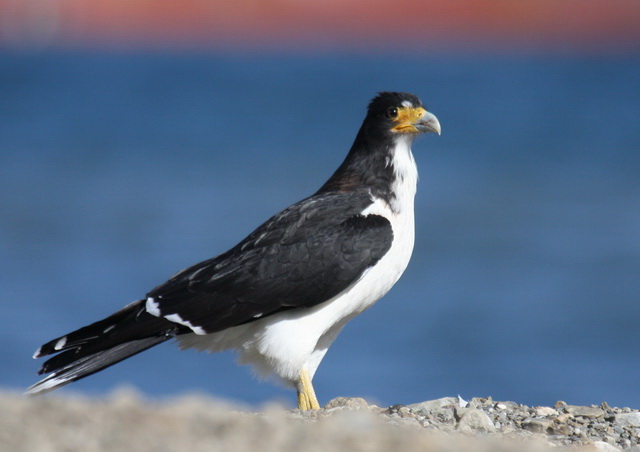
This morning we awoke to a dusting of snow on the jagged peaks of the mountains, and steady rain throughout the day. Nevertheless, we managed to bird the entire day. Hundreds of BLACK-BROWED ALBATROSSES plied the Beagle Channel along with SOUTHERN GIANT PETRELS (20), CHILEAN SKUAS (100), SOUTH AMERICAN TERNS (100), ROCK, IMPERIAL and NEOTROPIC SHAGS. On the road, we saw GRAY-FLANKED CINCLODES (1) and DARK-FACED GROUND TYRANTS (2). The "old" dump has not existed for years, but driving along the road to the new dump, we were able to see CHIMANGO CARACARA (50), SOUTHERN CRESTED CARACARA (18), and the much sought after WHITE-THROATED CARACARA (6). In addition, about 800 KELP GULSS and a handful of DOLPHIN GULLS were at the dump. A bonus bird, perched in a tree near the road was a BLACK-CHESTED BUZZARD EAGLE! This was the closest I have ever been to a buzzard eagle. After a quick breakfast in town, and a visit to our favorite natural history ```bookshop, a business meeting at Hotel Albatros, and pumping some air into a deflating tire, we headed to Tierra del Fuego National Park.


Birdlife was incredibly quiet inside the park. Maybe, it was the rain. Chimangos were everywhere, and I started to call them, Chickenmangos. Pishing finally brought on the THORN-TAILED RAYADITOS— at least 50 or more, all but landing on my head. They very much remind me of the little Bushtits in California, mobbing like crazy. Four of five, WHITE-THROATED TREERUNNERS were so agitated that they made their little cricket like sounds. Half a dozen AUSTRAL THRUSHES were feeding on some dark blue berries. Along the many lakes we found GREAT GREBES (6+ 2HY), YELLOW-BILLED PINTAILS (12), CHILOE WIDGEONS (4), FLYING STEAMER DUCKS (2), but missed the Spectacled Duck. Several UPLAND GEESE, along with 3 goslings were feeding along the roadside, ever so tame! We managed a couple of GRAY-HOODED SIERRA FINCHES, and several RUFOUS-COLLARED SPARROWS. Our big miss of the day was the Magellanic Woodpecker! We checked several places where we have seen them in past years with no luck. We stopped at a spot where we have previously seen Rufous-legged Owl at night— and, immediately heard the rayaditos mobbing an owl!! But, darned if we could see any owl in the thick, dark forest. It was a very long day, with a late dinner in town.


A few corrections on yesterday's log entry! Hey, I'm blaming it on jet lag! Seriously, there are a few identification snags that always get me in this area. The reported Ashy-headed Geese of yesterday, were in fact, Upland Geese. And, the steamer ducks always seem so difficult, but I think that we saw both Flying and Flightless Steamer Ducks, yesterday. Hey, I know the two that were at the lake today, were Flying Steamer Ducks, else how the heck did they get there! We do not have a spotting scope with us. And, the reported Silvery Grebe, was in reality a WHITE-TUFTED GREBE (no ID problem there, I was just brain dead).


Well, tomorrow, we hope to get up to the Martial Glacier to hunt for the White-bellied Seedsnipe, which I have never seen, but the weather forecast does not sound promising at all! Well, there you have it— a few hours of birding yesterday— when it was balmy, and we were casually sitting on the beach photographing the waterfowl, and a full day of birding today in rain, rain, rain.


At 4 pm tomorrow, we shall board Professor Multanovskiy and set off for the Drake Passage! For now, I hope that you will enjoy Don Doolittle's image of the raindrop covered BLACK-CHESTED BUZZARD EAGLE!


Til' tomorrow,

Debra


DEBRA SHEARWATER


831/637-8527

PO Box 190, Hollister, CA 95024


Antarctica, South Georgia, & The Falkland Islands: January 5-24, 2010

Exclusive charter with Debra Shearwater

Only 3.5 cabins available


Thursday, March 12, 2009

FIN DEL MUNDO: USHUAIA, ARGENTINA

Hello, Adventurers,

After 26 ± hours, Don and I have arrived in Ushuaia, Argentina— the town that calls itself, "Fin del Mundo," End of the World. Our travel here went remarkably well with no hitches with airlines or luggage! We departed San Francisco, California about noon yesterday for the 5 hour flight to Miami, Florida. Once, there, we connected to our eight hour American flight, non-stop to Buenos Aires, Argentina. We arrived on time, proceeded through immigration, which took about 40 minutes, and then claimed out bags, and made our way through customs. At the Aerolineas Argentina ticket counter, we learned that for $25 we could jump on an earlier flight, thereby avoiding a 5 hour wait for our scheduled flight! By the time we purchased the new ticket, the flight was boarding. Luckily, this was a non-stop flight, as often a stop is made at Rio Gallagos. Three and a half hours latter, we were on the ground at the small, but growing Ushuaia. The flight up the Beagle Channel was spectacular, with the jagged mountains all around.
On the ground, we wasted no time in renting a car, and began birding right at the airport ponds, and along other shorelines. Old friends, posed for our cameras: CHIMANGO (8) and SOUTHERN CRESTED CARACARA (9); KELP (350) and DOLPHIN GULLS (12); a couple ASHY-HEADED GEESE (3), many KELP GEESE (50) foraging on kelp; CRESTED DUCKS (200), CHILOE WIDGEONS (20), YELLOW-BILLED PINTAILS (30) FLYING STEAMER DUCKS (18); SOUTHERN LAPWING (4); NEOTROPICAL (12), IMPERIAL (30), and ROCK (3) SHAGS; MAGELLANIC (80) and BLACKISH (70) OYSTERCATCHERS; SOUTH AMERICAN TERNS (50); SILVERY GREBE (2); AMERICAN KESTREL (2), and GRAY-FLANKED CINCLODES.
After a couple of hours of birding, we checked in at Hostal Malvinas. Our friend and expedition leader, Troels, joined us for coffee. Dinner was at our favorite restaurant, Volver, which specializes in crab.
All flights on time, luggage delivered, a good start on birding, only a little bit of rain— we are off to a great start.


Debra Shearwater, Charter Master 2010
Don Doolittle, Expedition Photographer

DEBRA SHEARWATER
831/637-8527
PO Box 190, Hollister, CA 95024
Antarctica, South Georgia, & The Falkland Islands: January 5-24, 2010
Exclusive charter with Debra Shearwater
Only 3 cabins available

Friday, November 28, 2008

ANTARCTICA, SOUTH GEORGIA, FALKLAND ISLANDS, & WEDDELL SEA

Hello, Adventurers,

I would like to invite you to join Shearwater Journeys, Inc. on a unique, chartered voyage on the Professor Multanovskiy to Antarctica, South Georgia, The Falkland Islands, and into the Weddell Sea to search for Emperor Penguins, January 5-24, 2010. What's unique about it? 

For one thing, a brilliant assemblage of six Shearwater Journeys' leaders will be on board: Scott Terrill, Linda Terrill, John Sterling, Clay Kempf, Don Doolittle, and Debra Shearwater. Together we have over 100 years of ocean experience. We know seabirds and marine life! We've been involved in ocean trips for three decades. Each leader will be presenting lectures on such intriguing subjects as cutting edge knowledge of Adelie Penguins and climate change, Flora of the Falklands, Ice, history, geology, marine mammals —as well as fun things, such as Antarctic Jeopardy! (Who ever heard of that?)

Our small group size of 48 means that we offer one of the highest passenger/leader ratio of any voyage to the region— 6 SJ leaders, plus 2 Expedition staff, bringing you a richer experience.

Our itinerary focuses completely on wildlife, the stars of the voyage! We aim to make as many landings as possible for as long as possible, to give you an in-depth experience. 

Our voyage is scheduled at the absolute peak time of the year for wildlife activity— the height of the austral summer when penguins are with chicks.

Traveling with like-minded passengers allows for a more cohesive group.

Observe up to TEN SPECIES OF PENGUINS! We will be venturing into the Weddell Sea, near Snow Hill Island to make a dedicated search for EMPEROR PENGUINS. We will be searching for the single ERECT-CRESTED PENGUIN in the Falkland Islands, as well. By including the Chile pre-trip, add HUMBOLDT PENGUIN and possibly PERUVIAN DIVING PETREL to complete your diving petrel world list!

The voyage begins and ends in Ushuaia, Argentina which makes for a better air fare rate, eliminating the need for an "open jaw" ticket.

Our voyage is one of the best values for travel to the Antarctic region because no commission-earning travel agents are involved. Debra Shearwater, herself, communicates with each and every person. 

After thirtyfive years of ocean experience, and seventeen years of worldwide expedition experience, I have organized one of the best voyages to this region, ever. At this time, we have only 4.5 cabins available: 1 superior ($19895), and three Double Private ($16995), and one sharing female in a Double Private ($16995). If you are a single female, you will not need to find a cabin mate, as one is already available. Rates quoted are per person. Also at this time, we can offer a $1000 per cabin discount, or $500 per person, if booked by January 30, 2009. The night of January 5 at the Hotel Albatros in Ushuaia is included in the expedition fee. Detailed information can be found on the Shearwater Journeys' home page: www.shearwaterjourneys.com. To book your cabin, or for more information, please contact Debra Shearwater by email during the month of December. (I will be in Panama — there's more than seabirds in the world— and will have intermittent email). 

This is going to be a great trip, nothing ordinary about it! Our expedition leader has just returned from Antarctica, where he recently found 20 Emperor Penguins near Snow Hill Island! We are going to rock, big time on this voyage! Be there! 

Here's what Hadoram Shirihai has to say about this voyage: 

"I checked Debra Shearwater's Antarctic Voyage plan and found it to be the most attractive program to these remote wild areas on the planet. Since I have spent some time with Debra at sea, I am confident that she is the best qualified to lead such expedition to the Antarctic waters. What makes Debra different is that she is simply among the best seabird and marine-mammal observers in the world, eager to observe and to learn more about sea-life. She is an excellent organizer, too. Surely, Debra Shearwater's Antarctic Voyage is the best that one could dream about... Highly recommended!"

—Hadoram Shirihai, author of the definitive A Complete Guide to Antarctic Wildlife: The Birds and Marine Mammals of the Antarctic Continent and the Southern Ocean , A & C Black and Princeton University Press).

Penguins & Albatrosses forever,
Debra


Debra Shearwater
Shearwater Journeys, Inc.
PO Box 190
Hollister, CA 95024
831.637.8527
www.shearwaterjourneys.com

*Antarctica, South Georgia, & The Falkland Islands, January 5-24, 2010* 
Shearwater Journeys' Exclusive Charter


Sunday, March 9, 2008

ATLANTIC ODYSSEY

March 9, 2008

ATLANTIC ODYSSEY MARCH 4 – APRIL 23, 2008
TRIP REPORT
By
Debra Love Shearwater


Images are clickable to a larger size.

March 4 - 5, Tue/Wed: My travel companion, Don Doolittle, and I departed San Francisco International Airport at 11 am, changed planes in Dallas/Fort Worth, and arrived in Buenos Aires, Argentina about 10:30 am the next day after an uneventful, if tiring flight. We hired an official taxi to the Holiday Inn located in the Puerto Madero barrio of the city. (78 pesos) Headquartering ourselves at this hotel put us within easy walking or a short cab ride to all of the places that we wanted to visit.

Both of us are very familiar with this vibrant and bustling city, as it was my fifth and Don’s fourth visit to Buenos Aires. We headed straight to Costanera Sur Ecological Reserve. It was quite cloudy and humid. We dodged several rain showers, but nevertheless enjoyed observing some familiar birds— Rufous Hornero, strutting in the open, confiding Chalk-browed Mockingbirds, cackling Monk Parakeets, Picui Ground Doves, and Picazuro Pigeons. During the rain showers, we enjoyed watching many birds bathing in puddles on the wide paths, including some six Guira Cuckoos in one tree, Rufous-bellied Thrushes, and two Plumbeous Rails! Heading back to the hotel in the late afternoon, we enjoyed a great lunch at one of BA’s many sidewalk cafes, La Barra at Avenida Cordoba and San Martin. We retired to our room early to relax and catch up on some needed sleep.

March 6, Thu: Rising early, we again headed straight for Costanera Sur. This time, we took the trail that led to the Rio de la Plata River. Many Double-collared Seedeaters, Hooded Siskins, and Black and Rufous Warbling Finches were feeding on weedy stalks along the path. The wide, muddy brown river was devoid of birds, save a few Olivaceous Cormorants and one Kelp Gull, although soaring overhead on a thermal were 40+ Wood Storks and one Roseate Spoonbill. Gray-breasted Martins began alighting on branches as yet another rain shower fell.

In the deep resaca, two Gray-necked Wood Rails meandered in the deep dark shadows of the shoreline, while a Narrow-billed Woodcreeper quietly made its way along the tree trunks. About 2:30 pm, we left the reserve to get some lunch at the same café we had visited yesterday.
With the weather looking very foreboding, we decided to visit some of our favorite places in this very European city of so many flavors—Florida Avenue for some shopping, Café Tortoni (established as a hang out for artists and politicos in 1859), Casa Rosada, and a stroll along the waterfront of the restored Puerto Madero.

Birds we saw during our two days in Buenos Aires: Rufous Hornero, Monk Parakeet, Black-hooded Parakeet, Chalk-browed Mockingbird, Picui Ground Dove, Eared Ground Dove, Picazuro Pigeon, Rufous-bellied Thrush, Creamy-bellied Thrush, Bay-winged Cowbird, Red-crested Cardinal, Green-barred Woodpecker, Greater Yellowfinch, Masked Yellowthroat, House Wren, Double-collared Seedeater, Shining Cowbird, Greater Kiskadee, Southern Lapwing, Black and Rufous Warbling Finch, Brown-chested Martin, Crested Caracara, Guira Cuckoo, Grayish Saltator, Olivaceous Cormorant, Plumbeous Rail, Hooded Siskin, Roadside Hawk, American Kestrel, Red-backed Hawk, Great Egret, Glittering-bellied Emerald, Tropical Kingbird, White-lined Tanager, Wood Stork, Roseate Spoonbill, Kelp Gull, Black-capped Warbling Finch, White-crested Eleania, and Golden-billed Saltator.

Debra