Showing posts with label albatross. Show all posts

Wednesday, August 13, 2014

IMAGES OF THE DAY BY ABE BORKER: JULY 26, 2014 HALF MOON BAY

Shearwater Journeys's leader, Abe Borker captured these images on our July 26, Half Moon Bay pelagic birding trip. From largest to smallest — 
SALVIN'S ALBATROSS
SALVIN'S ALBATROSS
SALVIN'S ALBATROSS
SALVIN'S ALBATROSS
BLACK-FOOTED & SALVIN'S ALBATROSSES
BLACK-FOOTED ALBATROSS
 NORTHERN (PACIFIC) FULMAR
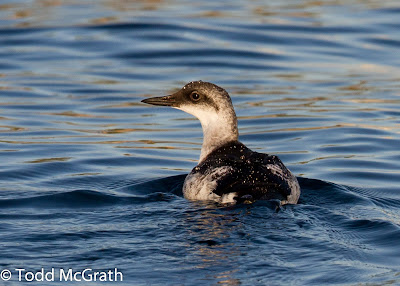
CRAVERI'S MURRELETS 
 CRAVERI'S MURRELET
CASSIN'S AUKLET
 BY-THE-WIND-SAILORS
 Abe is currently en route to Antarctica where he studies seabirds. 
All images, copyright, Abe Borker.
Please do not use without permission. 
LIFE IS GREAT — AT SEA ON A SUCH A DAY AS THIS! 
ALBATROSSES FOREVER,
DEBI SHEARWATER
debi@shearwaterjourneys.com

Monday, July 28, 2014

SALVIN'S ALBATROSS: Second Record for North America!

SALVIN'S ALABATROSS (Thalassarche salvini):
 First Record for California
Shearwater Journeys's July 26, 2014 pelagic trip from Half Moon Bay, California had many outstanding seabirds, and the SALVIN'S ALBATROSS topped the species list!
It was already a fantastic day at sea when we received a call from another birding group that they had spotted the Salvin's Albatross. We were ten miles away and motored over as quickly as possible to find this albatross sitting near a raft for BLACK-FOOTED ALBATROSSES. Earlier in the day, we had called the other group about a LAYSAN ALBATROSS which they motored over to see. 
Additional highlights of this trip included: BULLER'S SHEARWATER (first of the season); ASHY STORM-PETREL; all three species of jaegers: POMARINE, PARASITIC, and LONG-TAILED; SABINE'S GULL; SCRIPP'S and CRAVERI'S MURRELETS. The murrelets are particularly "good finds." A single male ORCA made a brief appearance. 
BLACK-FOOTED ALBATROSS, left and SALVIN'S ALBATROSS, right.
The taxonomy surrounding the so-called, "shy albatross" group has been in flux, with some countries splitting the group (Tasmanian/Auckland, Salvin's, Chatham). Recently the AOU has made some splits with Salvin's, Chatham and Tasmanian each being full species, so I've been told. 
There is only one record of Salvin's Albatross for North America, near Kasatochi Island, western Aleutians, 4 August 2003, making this the second record for North America and first for California. More details can be found in Steve Howell's publications, below. 


Shearwater Journeys's trips found an adult Tasmanian Albatross and Chatham Albatross on pelagic trips departing from Bodega Bay, 
All images, copyright, STEVE TUCKER, leader for Shearwater Journeys. 
Please do not use without permission. 

Spaces are still available on our HALF MOON BAY trips:
AUGUST 1, 16, 17, 23
SEPTEMBER 7, 8, 15, 24
OCTOBER 5, 12

Below, is our complete species list for July 26th. I'll post a trip report on my blog soon. Many thanks to all who joined us from near and far. Our leaders on this day included: Todd McGrath, Scott Terrill, Linda Terrill, Steve Tucker, Abe Borker, and Debi Shearwater. I have experience with Salvin's Albatrosses not only on many pelagic trips off the coast of Chile, but also at their breeding islands: Bounty, Snares and the Forty Fours. And, I'll be heading to those islands, again, at the end of this year! Berths are still available.

JULY 26, HALF MOON BAY with SHEARWATER JOURNEYS: SAN MATEO/SAN FRANCISCO COUNTY
LAYSAN ALBATROSS- 1/0
BLACK-FOOTED ALBATROSS- 40/20
NORTHERN FULMAR- 1/5
PINK-FOOTED SHEARWATER- 110/150
BULLER'S SHEARWATER- 0/1
SOOTY SHEARWATER- 160/30
ASHY STORM-PETREL -1/3
BROWN PELICAN- 40/0
BRANDT'S CORMORANT- 90/0
DOUBLE-CRESTED CORMORANT- 15/0
PELAGIC CORMORANT- 2/0
BLACK TURNSTONE- 20/0
SURFBIRD- 13/0
RED-NECKED PHALAROPE- 55/54
POMARINE JAEGER- 1/0
PARASITIC JAEGER- 1/0
LONG-TAILED JAEGER- 0/3
HEERMANN'S GULL- 40/0
CALIFORNIA GULL- 30/10
WESTERN GULL- 180/10
SABINE'S GULL- 19/1
ELEGANT TERN- 35/0
COMMON MURRE- 305/14
PIGEON GULLIMOT- 9/0
SCRIPP'S MURRELET- 2/0
CRAVERI'S MURRELET- 5/0
CASSIN'S AUKLET- 6/4
RHINOCEROS AUKLET- 1/1
CALIFORNIA SEA LION- 70
STELLER'S SEA LION- 2
NORTHERN FUR SEAL- 1
HUMPBACK WHALE- 4
KILLER WHALE- 1, ADULT MALE
NORTHERN RIGHT WHALE DOLPHIN- 40
RISSO'S DOLPHIN- 12
PACIFIC WHITE-SIDED DOPHIN- 120
HARBOR PORPOISE- 4
OCEAN SUNFISH- 60
BY-THE-WIND-SAILORS- ++
MOON JELLY- 6
EGG YOLK JELLY- 2

Want to see SALVIN'S ALBATROSS on the breeding islands? Join me on the Birding Down Under Voyage to New Zealand's sub-Antarctic islands, November 9 - 25, 2014! Berths are still available!

ALBATROSSES ALWAYS,
DEBI SHEARWATER
debi@shearwaterjourneys.com


Monday, June 10, 2013

THE SNARES or TINI HEKE: BIRDING DOWN UNDER VOYAGE

The closest group to mainland New Zealand, and the most hospitable, The Snares are about 100 km southwest of Stewart Island— just half a day's sailing. There are two distinct clusters: a main group featuring North East Island and adjacent Broughton Island, and a line of small islands called the Western Chain, 3.5 kim southwest of the main cluster. These islands are appropriately called The Snares as they were once considered a hazard for sailing ships. They are uninhabited. 

We plan to arrive early in the morning on Day 3 of the Birding Down Under voyage, November 9 to 25, 2014. Landing on the islands is not possible, as there are so many nesting birds that one would literally be stepping on birds! We will Zodiac cruise along the sheltered eastern side of the main island. If the weather and sea conditions are favorable in the sheltered bays, we should see the endemic Snares Crested Penguin, Snares Island Tomtit and Fernbirds. Cape Pigeons, Antarctic Terns, White-fronted Terns and Red-billed Gulls are also present in good numbers. There are hundreds of thousands of Sooty Shearwaters nesting in underground condominium-like burrows on The Snares; the actual number is much debated. The Buller's Albatross breed here from January onwards. We hope to see some arriving individuals. 

Among the islands of the Southern Ocean, The Snares has the distinction of being the only forested group without introduced mammals, not even mice. As such it is a remarkable haven for wildlife. Granite cliffs surround the bulk of the group, and erosion by the sea has produced deep narrow caverns, sink holes and gulches. Lying close to the Subtropical Convergence, The Snares group enjoys a climate that is surprisingly uniform throughout the year. The mean annual temperature is 11 degrees C, 51.5 degrees F. 

After the Sooty Shearwater, or titi, the bird most closely associated with The Snares is the Snares Crested Penguin. They typically gather in groups under the tree daisies and sometimes perch on the bent over trunks. Around the coastline, the New Zealand Fur Seal and New Zealand Sea Lion are breeding. Forests of the large tree daisy are the dominant feature across about 80 percent of the main islands. It may seem strange to see penguins standing on tree limbs! There are other plants, birds and insects. This is a simple introduction to a very unique place. 
Image by Doug Koch, copyright.

For those who have seen Sooty Shearwaters on West Coast pelagic trips—
Debi Shearwater

Wednesday, May 23, 2012

CORDELL BANK & BODEGA CANYON SEABIRD TRIPS

Howdy, Seabirders,

Since 1980, Shearwater Journeys has offered pelagic trips departing from Bodega Bay, north of Point Reyes and San Francisco. The vessel for all of our departures this season will be the New Sea Angler, a 65' comfortable sportfisher. The New Sea Angler and Trek II (used for our Fort Bragg departures), are two of the best birding boat platforms along the California coastline. We have used the New Sea Angler for many years. Her captain is intimately acquainted with birding and birders. 

Cordell Bank and Bodega Canyon have held an immense array of rare seabirds over the 30+ years that we've operated in these waters. Some of these seabirds have included: LAYSAN, "SHY" (3 records), LIGHT-MANTLED and SHORT-TAILED ALBATROSSES; MURPHY'S, COOK'S, HAWAIIAN, WHITE-CHINNED, PARKINSON'S and GREAT-WINGED PETRELS; STREAKED, CORY'S, GREAT, FLESH-FOOTED, WEDGE-TAILED and MANX SHEARWATERS; WILSON'S and LEAST STORM-PETRELS; LONG-BILLED MURRELET; CRESTED AUKLET. These are some of the rarest of the rare, seabird records. Todd McGrath found a very rare, WHITE-CHINNED PETREL on October 16, 2011 Bodega Bay trip!

The Cordell Bank is a National Marine Sanctuary which was established in 1989. It is an extraordinary ecosystem. Whales and other marine mammals are often abundant on these trips. White Sharks are sometimes encountered. 

SHEARWATER JOURNEYS' 2012 TRIPS TO CORDELL BANK & BODEGA CANYON:
AUG. 22, WED. (Can be combined with Fort Bragg trips, August 24 & 25)
SEP. 21, FRI.
SEP. 27, THU. - LIMITED SPACES AVAILABLE AT THIS TIME
OCT. 26, FRI. 

All of our Bodega Bay trips depart at 6:30 a.m. Parking is free. For complete trip details, click here. And, more details, here. Some trip reports: August 17, 2011; October 16, 2011; September 17 & 19, 2002 (Streaked Shearwater & Hawaiian/Dark-rumped Petrel); September 16, 2005 (Cook's Petrel); and many more Trip Reports. 

Hope to see you out there!
Shearwaters forever,
Debi Shearwater

Thursday, November 3, 2011

IMAGES of the DAY by TODD MCGRATH: OCTOBER 29, 2011 BODEGA BAY

Howdy, Birders,

Leader, Todd McGrath's stunning images of the Shearwater Journeys' October 29 2011 pelagic trip departing from Bodega Bay are below. All images copyright, Todd McGrath. Please do not use without permission. Enjoy! Read the full trip report here.
Bodega Rock, above, is usually covered with CALIFORNIA SEA LIONS.
A Gull, obviously, of undetermined species— possibly a HERRING X GLAUCOUS.
Bodega Headlands, often a spot to check the day prior to the pelagic trip.
WILLET, above. On the long ride into the harbor, the tide was as low as I have ever seen it, exposing large bodies of mudflats, covered with thousands of shorebirds.
A HABOR SEAL, on the exposing mud flats, inside of the harbor.
COMMON MURRE, above.
LAYSAN ALBATROSS, incoming!
RHINOCEROS AUKLET, above.
FLESH-FOOTED SHEARWATER, a Life Bird for some folks on board. Flesh-footed Shearwaters were found on every Shearwater Journeys' October boat trips, 2011.
BULLER'S SHEARWATER, above. Getting late for this species.
BLACK-FOOTED ALBATROSS. We were surprised that we did not see very many.
NORTHERN FULMAR, above. Numbers of fulmars should build throughout the winter months.
PINK-FOOTED SHEARWATER, above. Some individuals remain throughout the winter, but most have departed for nesting in the Southern Hemisphere.
THAYER'S GULL, (HY) above, generated a lot of interest. Jon Dunn tried his best to teach me more about gulls. I admit to the, "I don't do gulls" stand. Hybrids are just too tough for me, and tedious.
SOUTH POLAR SKUA, above. Again, it was quite the skua show!
NORTHERN FULMAR, above.
PINK-FOOTED SHEARWATER, above.
TUFTED PUFFIN. Well, as Linda Terrill said, "It is a great Halloween bird!"

Shearwaters Forever,
Debi Shearwater

Wednesday, October 12, 2011

IMAGES of the DAY by TODD MCGRATH: OCTOBER 8, 2011 MONTEREY BAY


Howdy, Birders,

Leader, Todd McGrath's images of the Shearwater Journeys' October 8, 2011 Monterey Bay trip are below. He has not yet worked through the many images of the Killer Whales. I'll post these, later. All images copyright, Todd McGrath. Please do not use without permission. Enjoy!

Leaving the harbor, we could tell it would be a beautiful day!
Just outside of the harbor, we spotted two PIGEON GUILLEMOTS, calling back and forth to each other. The lighting was beautiful.
The majority of Pigeon Guillemots depart during winter. It was only recently discovered that they spend the winter at the Queen Charlotte Islands.
The piercing scream of a SEA OTTER pup calling for its' mother attracted our attention.
The mother appeared at the surface with a crab. Nearly all of our Monterey Bay trips observe Sea Otters.
Cannery Row, above, does not bear any resemblance to what it once was— home of the largest sardine cannery in the world— until the sardines disappeared. Sardines are making a comeback and there is now a fishery for them, once again.
The beautiful BLACK-FOOTED ALBATROSS, above.
Prize seabird of the day: LAYSAN ALBATROSS, above.
SOOTY SHEARWATER, above.
BULLER'S SHEARWATER, above and below. We saw good numbers of these.
This LAYSAN ALBATROSS hung around for quite some time. Photographers had a field day! And, it was a Life Bird for more than a few folks on board!
Shearwaters & Auklets Forever,
Debi Shearwater
AKA: "Annie Auklet" as played by Angelica Huston in the movie, "The Big Year" opening on October 14th at a theater near you!